How Digital Trends Are Shaping Pest Control Marketing
Key Takeaways
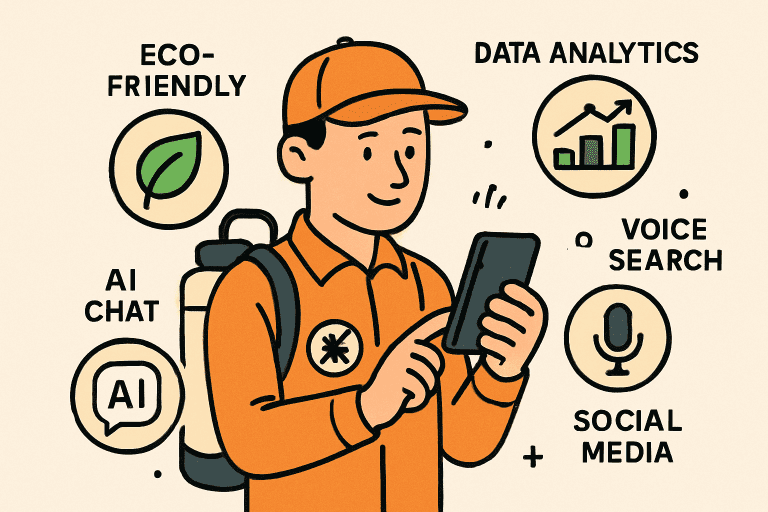
- Adopting eco-friendly practices not only enhances brand reputation but also meets consumer demand.
- Leveraging data analytics enables personalized marketing and enhanced service delivery.
- Optimizing for voice search and mobile-first indexing increases online visibility.
- Utilizing AI-powered customer communication tools improves responsiveness and efficiency.
- Integrating social media and referral programs expands reach and builds trust.
Table of Contents
- Leveraging Data Analytics
- Adopting Eco-Friendly Practices
- Optimizing for Voice Search
- Embracing Mobile-First Marketing
- Implementing AI-Powered Customer Communication
- Integrating Social Media and Referral Programs
- Conclusion
As digital transformation accelerates across industries, pest control companies are facing new opportunities and challenges in their marketing. The shift toward a more connected, tech-savvy, and eco-conscious consumer base means providers must adapt their approach to remain competitive in a crowded marketplace. For those looking to deepen their expertise and stand out in their service areas, resources such as the modern pest control marketing guide by Cube Creative Design are invaluable. This detailed guide provides the latest strategies for digital growth and local branding, leveraging Cube Creative Design’s proven expertise in digital marketing for pest control businesses, particularly those serving North Carolina and the Southeast.
Staying informed with strategic industry insights is crucial for companies aiming to build trust and expertise within their communities. Adapting to evolving digital trends isn’t just a strategy—it’s the foundation for sustainable growth. Businesses that implement data-driven, consumer-focused tactics are better equipped to thrive in today’s landscape, where transparency, responsiveness, and innovation set brands apart.
Leveraging Data Analytics
The most successful pest control companies are no longer making decisions based on guesswork. Using advanced data analytics, businesses can gather actionable insights from marketing ideas, campaigns and service delivery. These insights enable companies to identify high-value customer segments, forecast demand accurately, personalize outreach, and enhance operational efficiency.
Analytics tools help track key metrics, such as customer lifetime value, lead conversion rates, and seasonal service patterns. With this intelligence, resources can be allocated where they are most effective, resulting in better return on investment. Targeted marketing informed by precise data enables companies to connect with their audiences in truly meaningful ways, thereby improving both customer acquisition and retention.
For pest control professionals seeking innovative ways to capitalize on these trends, exploring creative pest control marketing ideas can spark new campaigns and approaches uniquely tailored to their markets.
Adopting Eco-Friendly Practices
In today’s market, environmentally conscious consumers are driving significant change. Pest control providers have responded by integrating sustainable service models, such as Integrated Pest Management (IPM). This approach prioritizes physical, biological, and highly targeted chemical solutions, ensuring effective results with the least environmental impact. By aligning operations with stringent regulations and sustainable values, companies foster trust with clients who value safe, non-toxic options in and around their homes.
Transparent and responsible practices have a profound impact on brand reputation. Eco-friendly brands are seen as forward-thinking, and they often benefit from word-of-mouth recommendations and enhanced customer loyalty. Companies that invest in green certifications and publicize their sustainability efforts differentiate themselves and comply with evolving consumer expectations.
Optimizing for Voice Search
The increasing use of voice assistants is transforming how consumers find local services. Phrases like “best pest control company near me” or “emergency ant exterminator” are common search queries made on the go. To stay competitive, pest control companies must tailor their websites for voice search by incorporating natural, conversational language, quick-loading mobile design, and location-specific information. Leveraging schema markup can also enhance local search results, helping businesses capture more voice-driven leads. Research from major digital marketing publications indicates that businesses optimized for voice inquiries benefit from increased visibility and higher click-through rates.
Embracing Mobile-First Marketing
With over 70% of service-related searches coming from mobile devices, delivering a seamless mobile experience has become non-negotiable. This means more than just having a mobile-responsive website; every element, from the homepage and contact forms to reviews and appointment booking, must be easy and intuitive to use. Google’s mobile-first indexing underscores the importance of fast page loads, responsive design, and secure browsing.
Poor mobile experiences can result in lost leads and lower search engine rankings. Investing in mobile optimization is a direct investment in lead generation and customer satisfaction. Easy navigation, click-to-call buttons, and clearly visible reviews all help capture in-the-moment inquiries from busy homeowners seeking pest control solutions.
Implementing AI-Powered Customer Communication
Artificial Intelligence (AI) is transforming customer service standards within pest control. Modern AI tools deliver more than basic responses—they assist in scheduling, quoting, and handling queries around the clock. For smaller and mid-sized companies, implementing AI solutions can level the playing field, providing 24/7 accessibility and freeing up staff to focus on complex inquiries and in-person service.
Personalized automated responses, smart appointment reminders, and even predictive booking based on previous service history are all in reach. Companies that harness these tools increase efficiency, maintain a competitive edge, and provide the fast turnaround that today’s customers expect. For insights into deploying these solutions effectively, up-to-date guides from leading business technology resources are invaluable.
Integrating Social Media and Referral Programs
Word-of-mouth marketing remains the gold standard for trust in home services. Social media amplifies these recommendations while allowing businesses to launch shareable referral programs. By encouraging customers to leave reviews, share promotional codes, and refer friends via platforms like Facebook and Instagram, pest control companies can expand their reach organically.
Referral incentives—such as discounts or complimentary services—motivate satisfied clients to become active promoters of your business. Integrated social media campaigns nurture community, showcase positive results, and position your team as approachable and responsive. Consistent, authentic engagement on these platforms translates to greater brand loyalty and more inbound leads over time.
Conclusion
The adoption of digital technologies and rising consumer expectations is reshaping modern pest control marketing. By embracing eco-friendly practices, harnessing data analytics, optimizing for voice and mobile, incorporating AI-driven communication, and leveraging social media to amplify word-of-mouth, forward-thinking pest control companies are building strong reputations and achieving sustainable growth. Continual education, innovation, and strategic implementation are essential for adapting to and outperforming the competition in a rapidly evolving industry.