
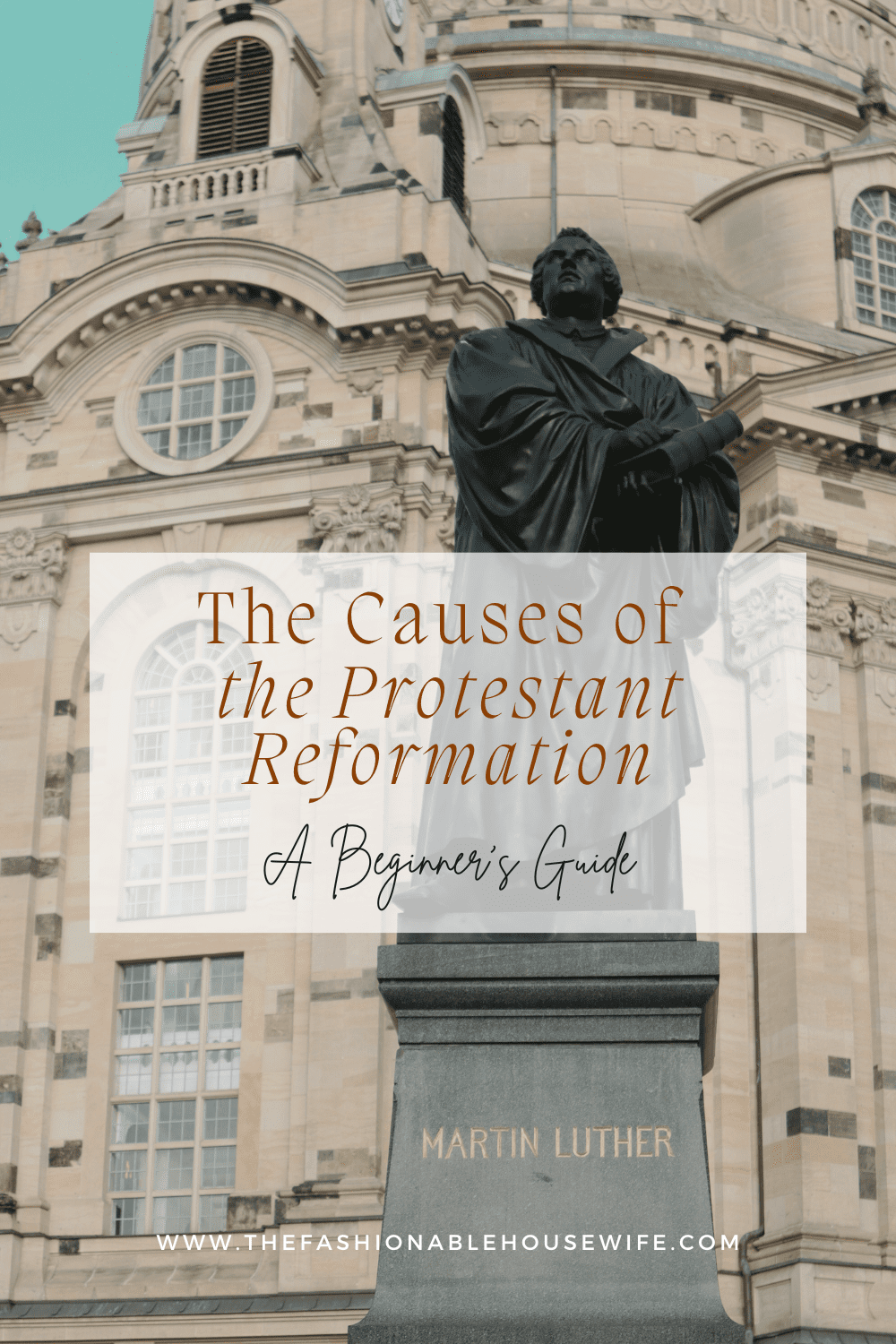
The Causes of the Protestant Reformation: A Comprehensive Guide
Table of Contents
- The Reformation – the main cause
- Religious Corruption and Church Practices
- Rise of Humanism and the Printing Press
- Political and Economic Factors
- Social and Cultural Changes
- Conclusion
As you probably already know, The Protestant Reformation was a major turning point in 16th century Europe, one that deeply wounded the unity of Christendom and changed the spiritual and political landscape for centuries. Understanding the causes of this rupture helps us see how religious abuses, political ambition, cultural change, and new technology all contributed to a tragic division within the Christian world.
There were real problems in need of reform. Some clergy were corrupt. Certain Church practices were abused. Many faithful Catholics longed for renewal, deeper holiness, and a more serious commitment to the Gospel. But the answer to corruption within the Church was never separation from the Church. True reform was needed, and true reform did happen within Catholicism. But the Protestant Reformation itself led many souls away from the fullness of truth preserved in the one, holy, catholic, and apostolic Church.
Religious Corruption and Church Practices
By the start of the 16th century, discontent with some Church leaders was widespread. One of the most troubling issues for ordinary believers was the abuse surrounding indulgences. Properly understood, indulgences are part of the Church’s teaching on the remission of temporal punishment due to sin. But in some places, the way they were promoted or connected to money caused scandal and confusion, overshadowing the need for genuine repentance, confession, penance, and conversion of heart.
Martin Luther’s Ninety-Five Theses were written in response to real abuses, especially the scandal surrounding the preaching and selling of indulgences. But while Luther correctly recognized that some things needed reform, he was deeply misguided in where he went from there. Instead of remaining obedient to the Church and seeking true reform from within, he rejected the authority Christ gave to His Church and eventually promoted errors that tore countless souls away from the fullness of the Faith. His protest began with concerns about corruption, but it did not end with faithful renewal. It led to rebellion, division, and doctrines that contradicted Catholic teaching on authority, Scripture, grace, the sacraments, and the Church herself.
These were real wounds. The Church did need purification. But corruption among some members of the Church does not disprove the Church’s divine foundation. Judas was one of the Twelve, and his betrayal did not make Christ’s mission false. The need was for Catholic reform, holiness, and repentance, not the rejection of Church authority or the creation of competing doctrines.
Rise of Humanism and the Printing Press
Another major factor in this era was the rise of humanism, an intellectual movement that encouraged study of original texts and ancient sources. Scholars began studying Scripture, the Church Fathers, and classical writings with renewed attention. This brought many valuable contributions to education and learning.
The printing press also transformed Europe. Ideas could spread much faster than before, and texts that once remained within scholarly circles became available to a wider audience. Pamphlets, sermons, theological arguments, and polemical writings traveled quickly across borders.
This increased access to texts had both benefits and dangers. Greater literacy and wider access to Scripture could help people grow in knowledge of the Faith when guided by the Church. But when Scripture was separated from Sacred Tradition and the teaching authority Christ gave to His Church, private interpretation quickly led to confusion and division. The spread of printed material helped fuel not only reform efforts, but also doctrinal rebellion, anti-Catholic propaganda, and the fragmentation of Christian belief.
Political and Economic Factors
Political ambition played a major role in the spread of the Protestant Reformation. Many kings, princes, and city leaders saw an opportunity to weaken the authority of the Church and gain more control over religious and political life in their territories. Some rulers embraced Protestant ideas not only because of theological conviction, but because it allowed them to seize Church lands, increase local power, and reduce the influence of Rome.
Economic factors also mattered. The Church was a major landowner and social authority, and many rising political and commercial classes resented that influence. In some places, support for Protestant reform became tangled with the desire for wealth, independence, and control.
This is important because the Reformation was not simply a pure spiritual movement of humble believers searching for truth. It was also deeply shaped by power, money, nationalism, resentment, and political calculation. Many people used religious language to justify actions that fractured Christian unity and served earthly ambitions.
Social and Cultural Changes
The Renaissance encouraged new interest in education, conscience, language, and learning. More people began reading religious texts in everyday languages, and lay involvement in religious discussion increased.
This cultural shift created both opportunity and danger. It is good for the faithful to know their Faith, read Scripture, study the saints, and grow in wisdom. The Catholic tradition has always valued learning, beauty, reason, and truth. But when personal interpretation becomes detached from the authority Christ gave to His Church, the result is not unity. It is division.
The Reformation opened the door to countless conflicting interpretations of Scripture. Once the authority of the Church was rejected, there was no stable foundation for doctrine. The result was not one restored Christianity, but an ever-growing number of denominations, all claiming Scripture while disagreeing with one another on essential teachings.
Conclusion
The Protestant Reformation was shaped by a complicated mix of real abuses, sincere concerns, intellectual change, political ambition, economic pressure, and cultural unrest. Some people involved may have genuinely desired renewal. But good intentions do not make division good. The Reformation was not a heroic return to a purer Christianity. It was a rupture from the visible Church Christ founded.
The answer to sin within the Church is repentance, reform, holiness, and fidelity. It is not leaving the Church. Jesus did not say, “On this rock I will build millions of denominations that cannot agree with each other.” He said, “On this rock I will build my Church.” Period. That rock was Peter, and the Church Christ founded is the one, holy, catholic, and apostolic Church.
The Reformation was a tragic point in history, and its effects still deceive many well-meaning Christians today. We should pray for unity, for truth, and for our separated brothers and sisters in Christ to come home to the fullness of the Faith in the Catholic Church. The Church has always needed saints and reformers, but true reform happens within the Church Christ gave us, not apart from her.